
If you had told me in 1986 that Commodore’s next big product would be a phone that refuses to let you browse the internet, I’d have assumed you meant a modem that was broken. Forty years later, that’s more or less the pitch.
The revived Commodore, now run by YouTuber and retro collector Christian “Peri Fractic” Simpson, announced the Callback 8020 back in June. It’s a clamshell flip phone with a T9 keypad that runs modern apps, takes real photos, and blocks TikTok, Instagram and every web browser at the system level. Permanently. Production started ramping this month and the first units are supposed to land on doorsteps in the next few weeks, so it’s a good time to ask the obvious question: in 2026, is a deliberately less capable phone a good idea?
What it actually is
This isn’t a cheap feature phone with a Commodore sticker on it. Under the shell it’s a small smartphone with the dangerous parts removed.
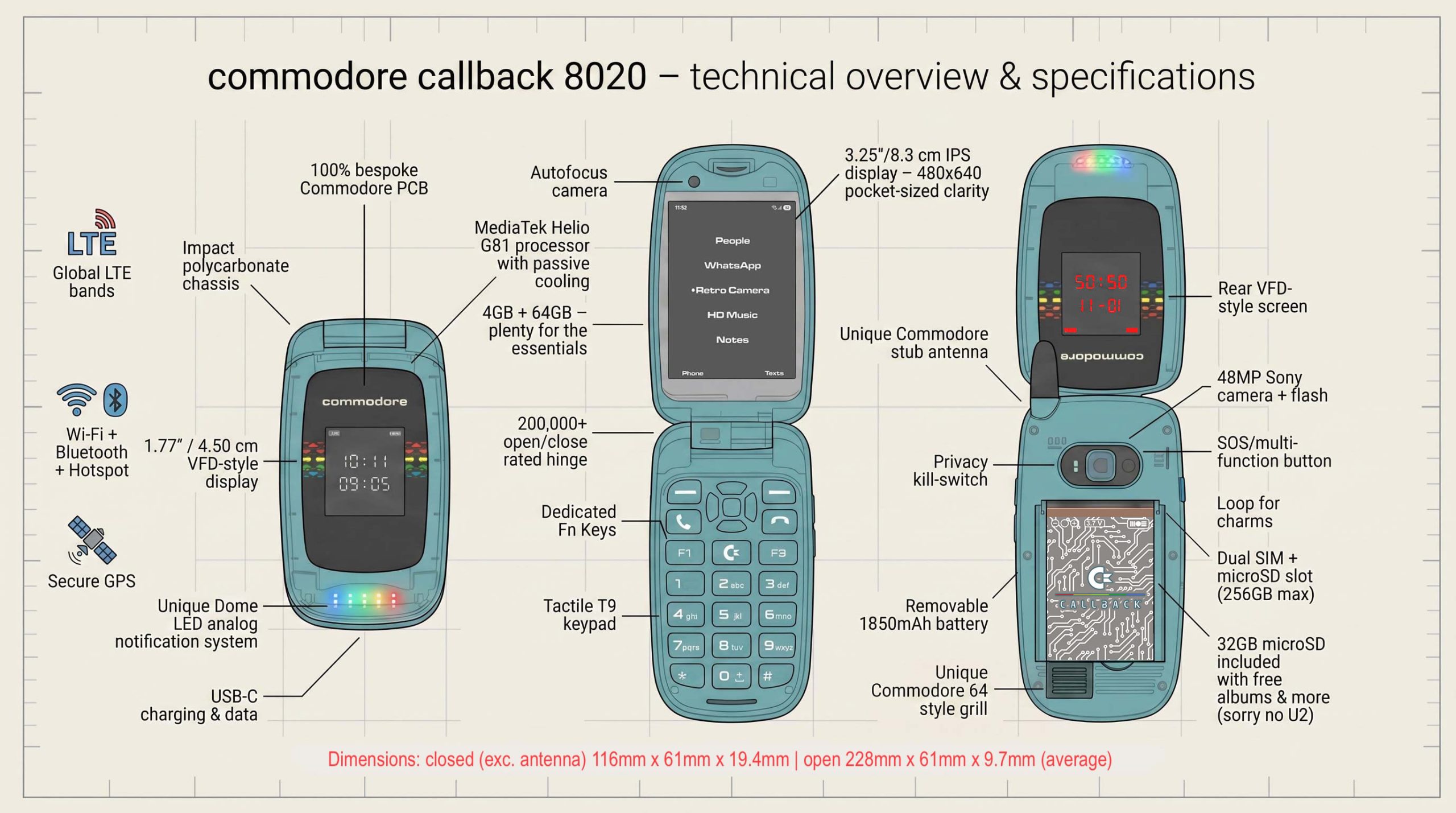
- OS: Jolla’s Sailfish OS, a Linux-based mobile OS descended from Nokia’s MeeGo work, customized with Jolla’s engineers. It runs Android apps through a compatibility layer, with no Google services except Maps.
- Hardware: MediaTek Helio G81, 4 GB RAM, 64 GB storage plus a 32 GB microSD card in the box, LTE, Wi-Fi, Bluetooth, GPS, dual SIM.
- Screens: a 3.25-inch 480×640 inner display (touch is off by default, so you drive it with the keypad) and a small outer screen for time, battery and signal, plus a colored notification LED.
- Camera: 48 MP Sony sensor.
- Battery: removable and swappable. Early specs said 1,550 mAh; this week’s launch coverage says 1,850 mAh. Treat that as unconfirmed until someone has one on a bench.
- Audio: a 3.5 mm jack (remember those?), an ESS/Cirrus Logic DAC with lossless support, and an FM radio. That stub antenna isn’t just decoration.
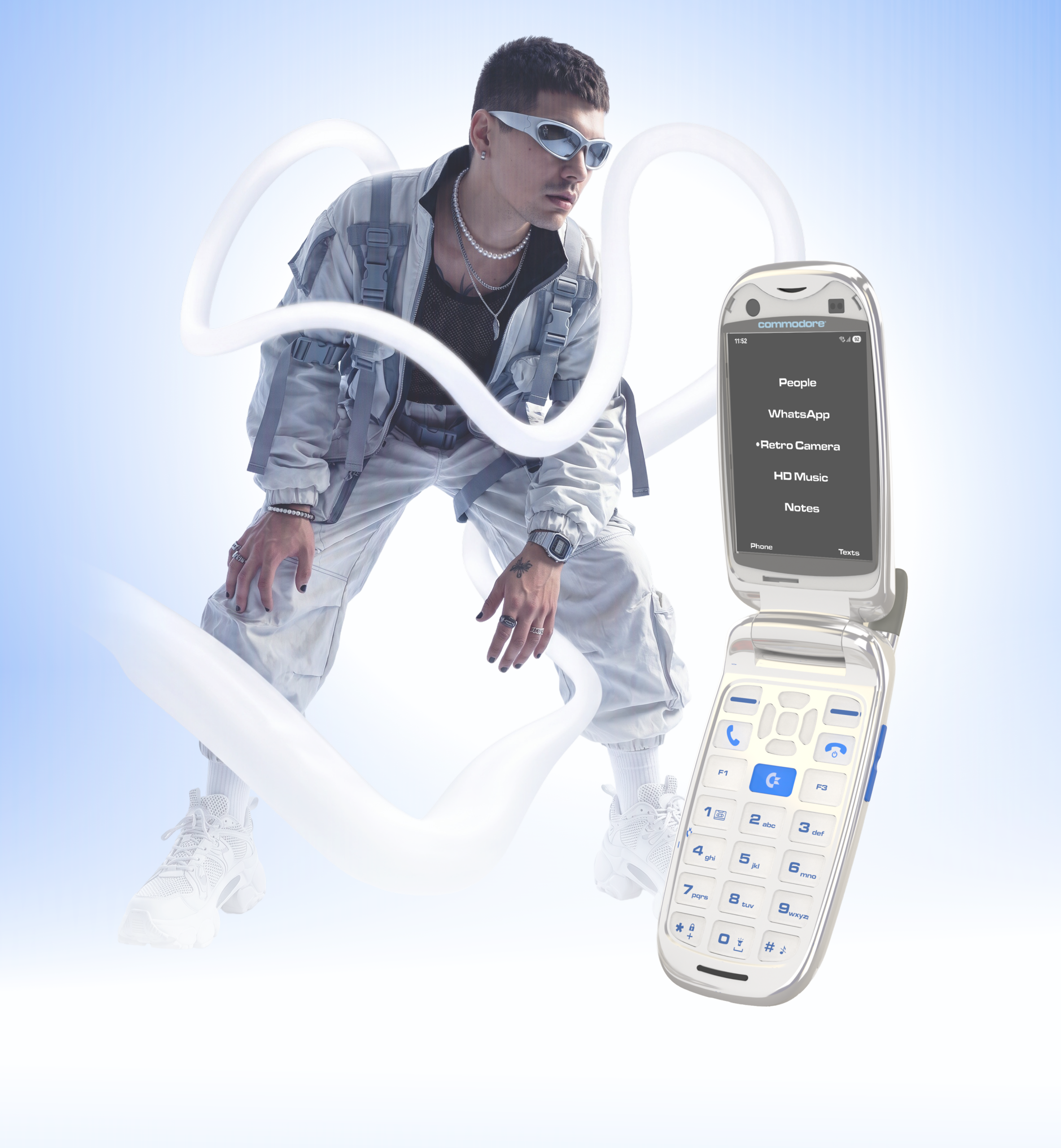
- The Commodore bits: five colorways named for the old machines (BASIC Beige, ProtoPET White, SX Silver, a translucent Starlight Edition, and a gold Founders Edition), a dedicated Commodore key, SID-chip ringtones, a handful of C64 games, and Snake. The 8020 name follows the 8010, an old Commodore modem.
The app policy is the whole product. Messaging (WhatsApp, Signal), maps, music streaming, rideshare and authenticator-type apps are in. Social media and browsers are out, hard-blocked, and email is off by default too. You can sideload APKs, but not anything on the blocklist.
One thing worth knowing about the marketing: Commodore’s product page notes that some product images are renders and some screen images are simulated, and its launch promo video admittedly used generative-AI elements, which drew criticism from fans and from CNET. Most photos you see of this phone, including the ones here, are not of a production unit yet.
Pricing: it moved before it shipped
Pricing has been a story of its own.
At announcement the standard colors were $499.99, Starlight was $549.99 and the Founders Edition was $640. The reaction was roughly “$500 for a flip phone?”, and a week later Commodore cut four of the five models to $399. Pre-order day added a waitlist code that took most models to about $349.
The fine print on that cut matters. The $399 phone ships with “eco-validated” RAM and storage, which is a polite way of saying remanufactured chips, still covered by a one-year warranty. New memory is a $50 upgrade, which puts you at $449. The bundled FiiO in-ear monitors also became an optional extra. So the honest comparison is closer to $449 for the phone most people would want.
For context, Commodore’s own comparison page puts the Mudita Kompakt at the same $399 and the Light Phone III at $899. Those are the phones this is really competing with, not the iPhone.
Availability
- Pre-orders opened June 30 and are still open at commodore.net. You’re charged up front, not Kickstarter-style, and you can cancel for a full refund any time before it ships.
- After trial production runs in Shenzhen in October, Commodore says full manufacturing ramps in early November, with first deliveries in late November to early December.
- Shipping is free worldwide at launch, and the phone is pitched as a global LTE device.
- The caveat: as of this week’s launch coverage, the U.S. units still needed FCC authorization before they can ship, and Commodore shows ship dates per order rather than promising a date. This is also the first phone this company has ever built. Delays wouldn’t shock me.
Why it might be a good idea
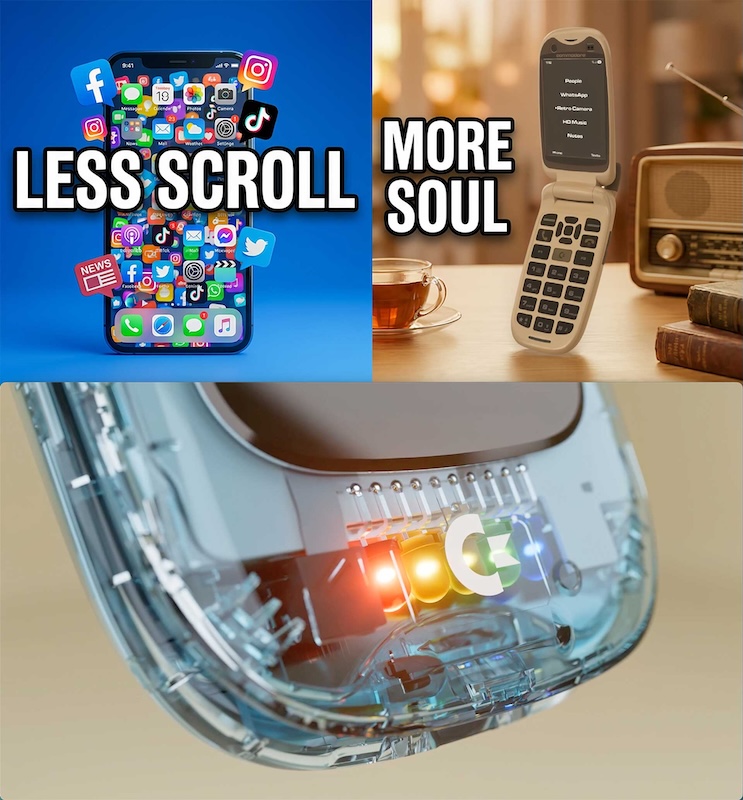
Friction is the feature. Every phone has screen-time tools and app blockers. They all have one thing in common: you can turn them off in about four seconds at 11:30 p.m. The Callback’s bet is that a limit you can’t undo is the only kind that works. A flip you have to open, a keypad you have to type on, and no browser to fall back on is a very different relationship with your phone than “I’ll just check one thing.”
It keeps the parts of a smartphone people actually need. The trouble with true dumbphones is everything else in life assumes a smartphone: group chats on WhatsApp, two-factor apps, maps, paying for parking, calling a ride. The Callback is the first detox phone from a recognizable brand that tries to keep the utilities and lose the feeds.
The audience is real. Parents shopping for a kid’s first phone, people who want a weekend or evening phone (dual SIM helps here), and a growing crowd who are simply tired. Governments are moving too: the UK announced a social media ban the same week the Callback was revealed, and it notably left messaging apps like WhatsApp alone. A phone built around exactly that line is good timing.
Removable battery, headphone jack, microSD, FM radio. Things the big makers took away, back in one device. That’s not nostalgia; that’s just good hardware.
Why it might not be (devil’s advocate)
$400+ for a 2022-class budget chip. The Helio G81 is an entry-level part, and the base model uses recycled memory. You could buy a $150 Android phone, install a blocker and lock the passcode with someone you trust, and get most of the effect for a third of the money. The counterargument is the one above: software blocks get bypassed. Whether that’s worth $250 is a personal call.
No browser breaks more than you think. This is the one that bugs me as an IT person. Hotel and airport Wi-Fi captive portals are web pages. So are a lot of password-reset links, utility payment pages, delivery tracking, and the “sign in with…” OAuth screens many apps pop up mid-login. Some apps handle this with an embedded web view; some just hand off to the system browser and fail. I don’t know yet how the Callback deals with these edge cases, and nobody will until reviewers live with it for a few weeks.
“99% of Android apps” deserves skepticism. De-Googled phones have a known weak spot: apps that lean on Google Play Services or Google’s device integrity checks. That historically includes some banking apps and tap-to-pay. If your bank’s app won’t run, that’s a dealbreaker for a primary phone. Wait for real compatibility reports before assuming your must-haves work.
No email is a dealbreaker for a lot of people. It’s off by default, and for anyone whose job lives in their inbox, that alone rules it out as a main phone.
Small company, small OS. Long-term security updates depend on Commodore and Jolla both sticking around and supporting it. Sailfish has a loyal following but a small ecosystem. A phone is a networked computer you carry everywhere; patch cadence matters more than the colorway.
And honestly, some of it is a costume. Commodore never made a mobile phone in its first life. The beige plastic and SID ringtones are fun, but they’re branding, not heritage. That’s fine, as long as buyers know they’re paying partly for the badge.
Where Commodore goes from here
Here’s what the new Commodore has actually shipped or announced since its 2025 revival:
- Commodore 64 Ultimate (2025): the FPGA-based “breadbin” C64 recreation that started it all; the company said in June it had passed 30,000 units.
- Commodore 64C Ultimate (2026): the slimline 1986 design, built with the restored original injection molds (flow marks and all), from $299.99. On sale since October 27, with first batches shipping.
- TAC-2 joystick (2026): the classic indestructible joystick, back with a steel shaft and still on a standard 9-pin plug, $49.99, shipping this fall.
- Callback 8020 (2026): the phone, plus its own accessory line (swappable back covers, a case and a belt holster).
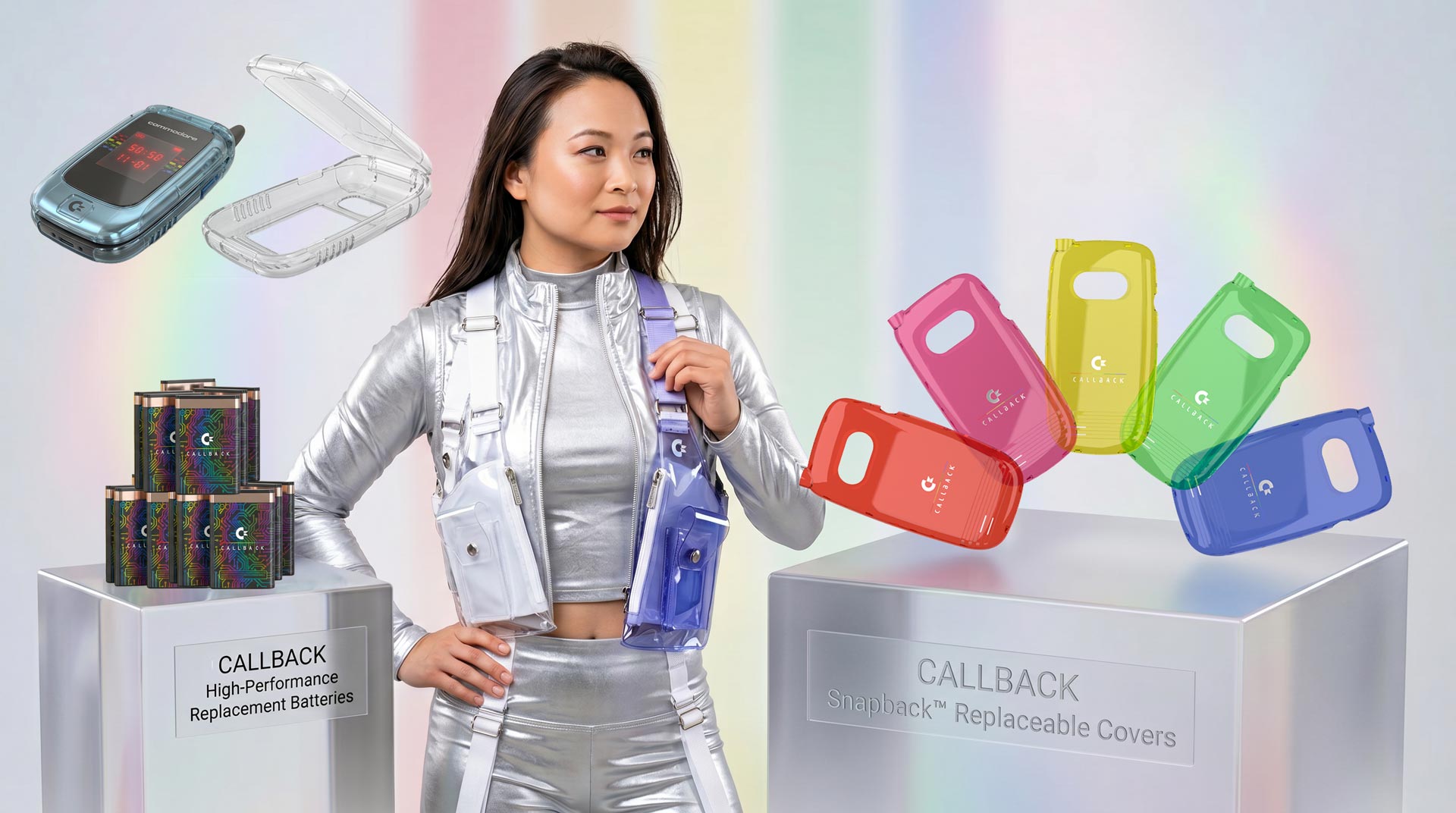
Commodore has said its 2026 roadmap includes “new platforms and accessories,” and Simpson has framed the company around preservation of the old machines and expansion of the C64 ecosystem. One thing to keep straight: the cute THEC64 Handheld you may have seen this fall comes from Retro Games Ltd, not from Commodore itself.
What I’d expect next (my speculation, not announced):
- More C64 ecosystem hardware. Drives, cartridges, a 1541-style storage peripheral, monitors in period styling. Accessories are cheap to make, sell to an existing customer base, and the TAC-2 shows they’re already doing it.
- A Callback 2 or a “non-flip” variant if this one ships cleanly and the software holds up. The Snapback covers suggest they’re thinking in terms of a platform, not a one-off.
- Other 8-bit machines. A VIC-20 or PET-style FPGA recreation is the obvious next step for a company that just proved it can bring back original tooling.
- Probably not an Amiga, at least not soon. The Amiga rights sit with a different company, and Commodore’s own leadership has talked about how the two brands were split up and licensed out over the years. I’d love to be wrong.
The bigger strategic question is whether Commodore wants to be a retro computer company or a retro-styled consumer electronics brand. The C64 line is the first; the phone is the second. The phone is the riskier bet, and how this first shipment goes will tell us which path they take.
My take
I like the idea more than I expected to. The Callback is honest about what it is: a tool for people who already know their phone is a problem and want a physical boundary, not a willpower app. The hardware choices (swappable battery, headphone jack, real camera) are better than most $400 phones in 2026.
But I wouldn’t pre-order one today unless you’re a Commodore fan who’s fine being an early tester. Wait for the first real-world reviews. The things that will make or break it (banking apps, captive Wi-Fi, battery life, update support) can’t be judged from a spec sheet. If those check out, this could be the best “second phone” or “first phone for a teenager” on the market. If they don’t, it’s a very nice-looking way to miss a two-factor code.
Would you carry one? I’m genuinely curious where people land on this.
Watch
Commodore’s official hands-on video (embedded on the Callback product page):
A creator took viewer questions straight to Commodore, a good follow-up on the stuff the launch didn’t answer:
The skeptic’s case, asking whether it’s just an overpriced flip phone:
Sources
- Commodore: Callback 8020 product page (images, hands-on video)
- CNET: generative-AI marketing images
- Time Extension: Commodore on the GenAI promo video
- Commodore: Callback 8020 vs. competitors (Nov 2026 production update)
- Commodore: From the Factory Floor (Callback, C64C, TAC-2)
- The Gadgeteer: Callback 8020 is official (Nov 10)
- The Gadgeteer: the $100 price cut and pre-order caveats
- GSMArena: announcement and original pricing
- GSMArena: $399 pre-order and “eco-validated” memory
- Tom’s Hardware: specs, app policy, accessories
- Video Games Chronicle: Sailfish/Jolla partnership and UK social media ban timing
- designboom: design and naming
- Tom’s Hardware: C64C Ultimate and the 2026 roadmap
- Verge Magazine: C64C Ultimate on sale Oct 27
- Tom’s Hardware: TAC-2 joystick returns
- Generation Amiga: THEC64 Handheld (Retro Games Ltd)